
Voxel Size vs Spatial Resolution: What Really Determines CBCT Image Clarity?
When comparing dental CBCT systems, voxel size is often one of the first specifications people look at. A smaller voxel sounds simple: smaller must mean more detail and therefore a clearer image.
But CBCT imaging is more complex than that. To understand how today’s systems reached this level of imaging performance, explore the evolution of dental CBCT.
Voxel size determines how finely a reconstructed 3D volume is sampled. Spatial resolution describes how much real detail the imaging system can actually distinguish. The two are related, but they are not the same.
So, when evaluating CBCT image quality, which matters more?
What is a voxel?
A voxel, short for volume element, can be thought of as a three-dimensional pixel.
A 2D digital image is made up of pixels. A CBCT volume is made up of thousands or millions of small three-dimensional elements called voxels. In most dental CBCT systems, these voxels are isotropic, meaning their height, width and depth are equal. |
|
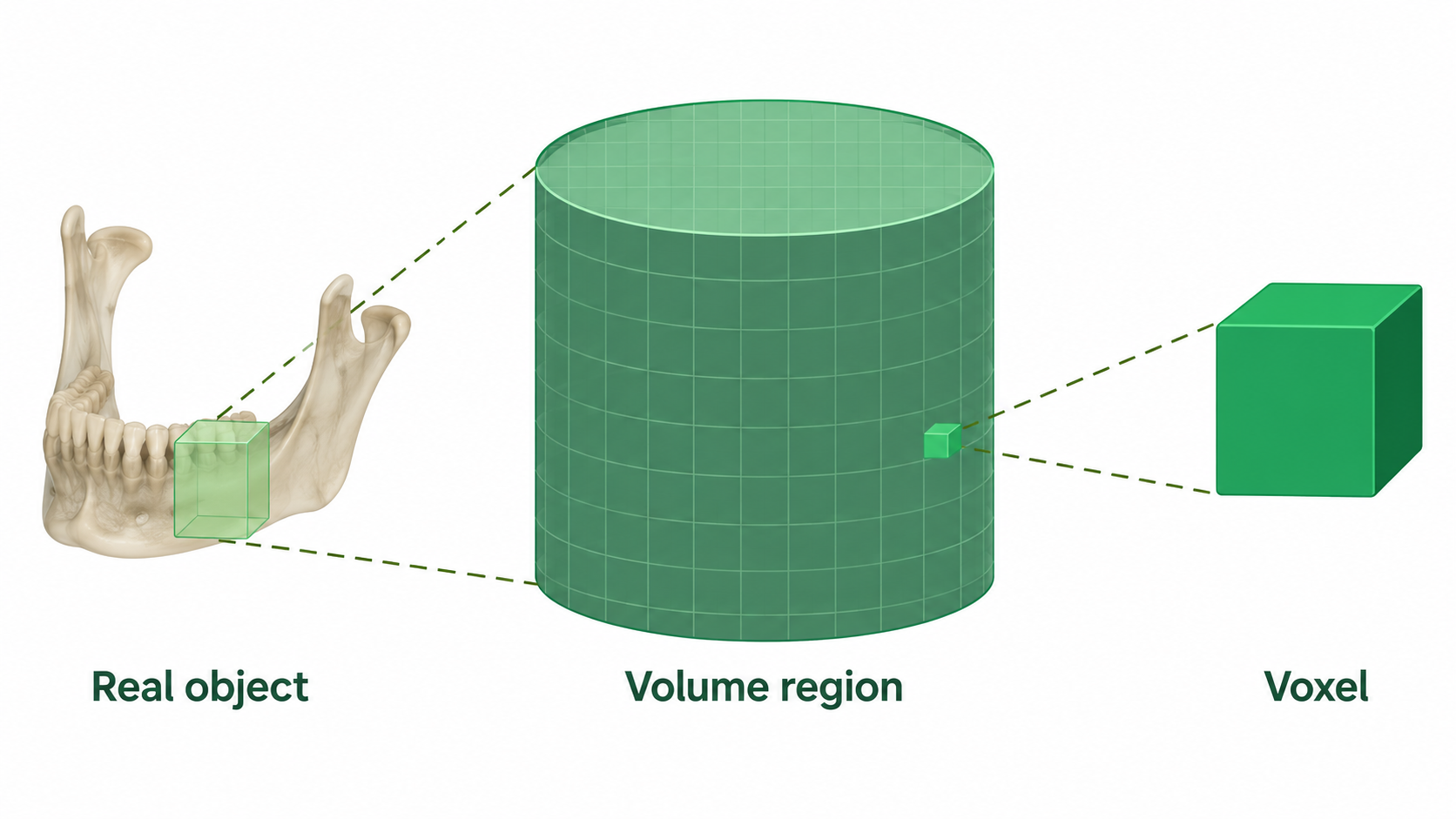
For example, a voxel size of 0.2 mm means that the reconstructed volume is divided into cubes measuring approximately 0.2 × 0.2 × 0.2 mm.
Smaller voxels create a finer sampling grid and can therefore provide the basis for displaying finer structures.
But this does not mean that a system with smaller voxels will automatically produce a sharper image.
Research into dental CBCT has repeatedly shown that voxel size should not be treated as equivalent to actual spatial resolution. Effective resolution is influenced by the complete imaging chain, including the detector, reconstruction process, scan geometry and patient movement.
A simple way to think about it
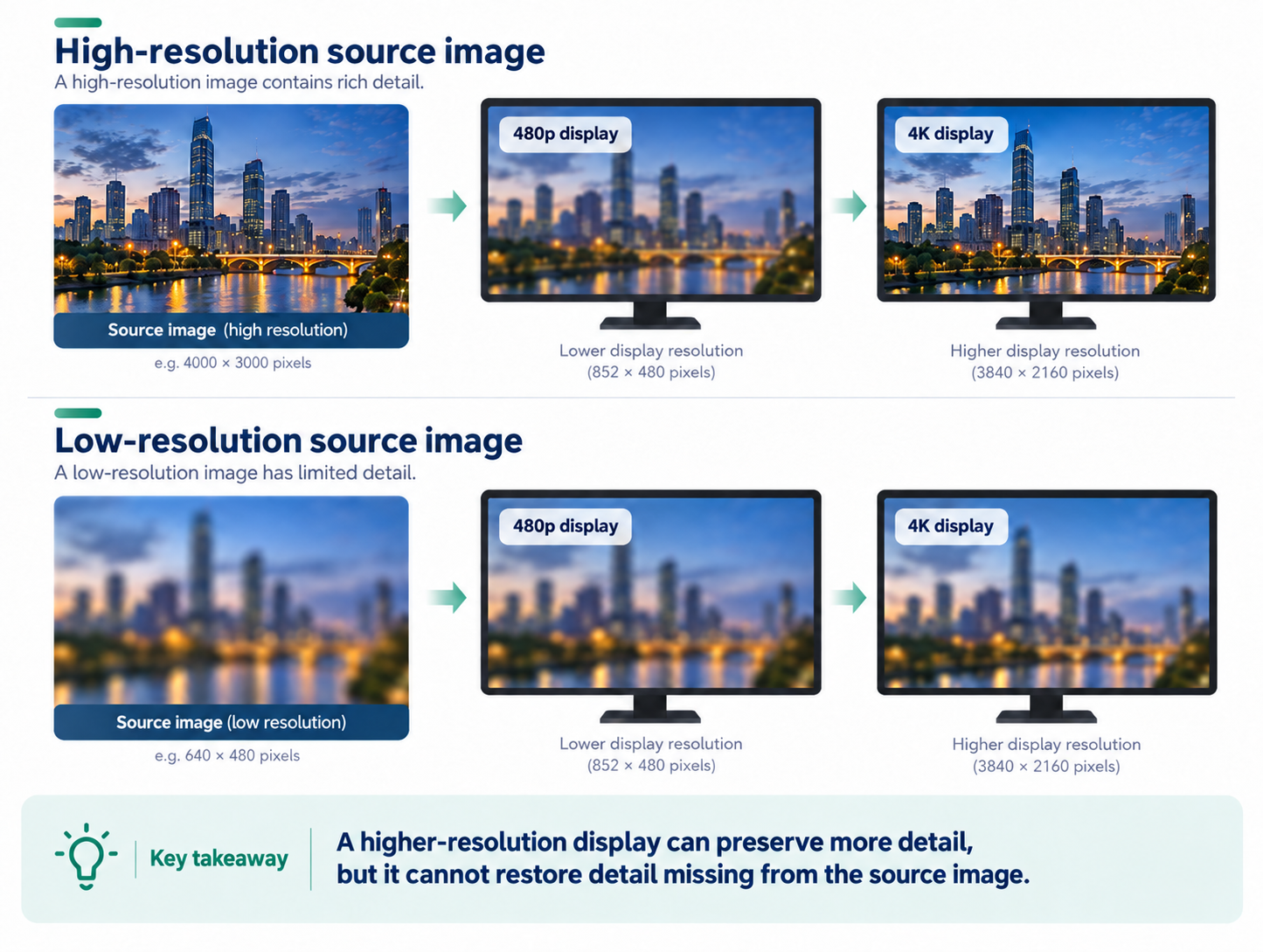
Imagine enlarging a slightly blurred photograph and dividing it into more and more pixels.
You now have more pixels, but you have not recreated detail that was never captured in the original image.
CBCT follows a similar principle. A smaller voxel can preserve fine information that the system has captured, but it cannot create detail that has already been lost elsewhere in the imaging process.
What is spatial resolution?
Spatial resolution describes an imaging system's ability to distinguish two small structures that are close together.
In dental imaging, this is particularly important because clinicians often need to evaluate fine anatomical structures and subtle changes in hard tissue.
Spatial resolution can be measured using line pairs, commonly expressed as:
lp/mm: line pairs per millimetre or lp/cm: line pairs per centimetre
A line-pair phantom contains groups of closely spaced high-contrast lines. The more closely spaced lines an imaging system can distinguish as separate structures, the higher its spatial resolution.
In practical terms, higher spatial resolution allows finer anatomical detail to be distinguished more clearly.
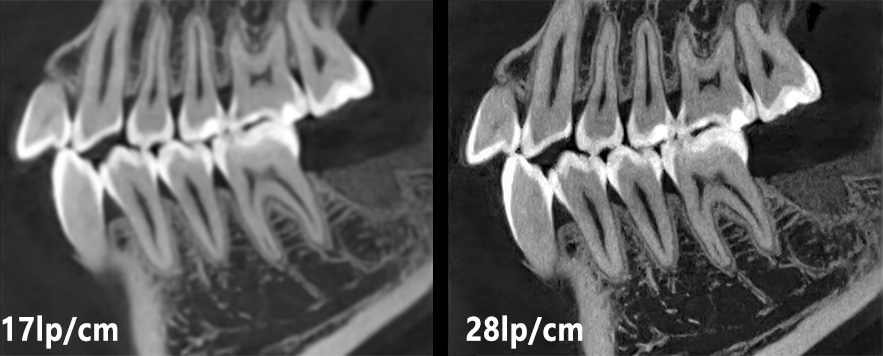
Spatial resolution comparison: 17 lp/cm vs 28 lp/cm
For example:
28 lp/cm = 2.8 lp/mm
A higher line-pair value generally indicates a greater ability to resolve fine high-contrast detail.
More advanced technical evaluation can also use modulation transfer function, or MTF, which measures how effectively an imaging system transfers detail at different spatial frequencies. Line-pair testing is easier to understand visually, while MTF provides a more objective description of system resolution.
Does a smaller voxel mean better spatial resolution?
Up to a point, voxel size matters.
A voxel must be sufficiently small to sample the detail being imaged. According to the basic principles of digital sampling, the sampling interval places a theoretical limit on the spatial frequencies that can be represented.
However, real CBCT systems do not operate under ideal conditions.
The final spatial resolution is usually lower than the theoretical resolution suggested by voxel size alone. Detector characteristics, focal spot size, reconstruction, mechanical accuracy, scatter and motion can all reduce the amount of usable detail in the final image.
This is why two CBCT systems using the same voxel size can produce noticeably different images.
Voxel size tells you how finely the image is reconstructed. Spatial resolution tells you more about how much detail the imaging system can actually distinguish.
Smaller is not always better
There is another reason not to judge CBCT performance by voxel size alone.
Using very small voxels can increase image noise because fewer X-ray photons contribute to each voxel. High-resolution protocols may therefore require different exposure parameters to maintain an acceptable signal-to-noise level, depending on the system and clinical task. Smaller voxels also generate larger datasets and increase reconstruction, processing and storage requirements.
The objective is therefore not simply to use the smallest voxel available.
It is to achieve sufficient diagnostic detail with an appropriate imaging protocol and radiation dose.
What really determines CBCT image quality?
Spatial resolution is important, but overall image quality is the result of several factors working together.
Four fundamental elements are particularly relevant:
Spatial resolution
How well the system can distinguish small, closely positioned structures.
Contrast
How effectively different tissues and materials can be differentiated.
Noise
Random variation in the image that can obscure useful information.
Artefacts
Image distortions caused by factors such as metal, scatter, motion or system geometry.
These characteristics interact with one another. Improving one parameter does not necessarily improve the entire image.
The effective resolution of a CBCT system can therefore be influenced by the whole imaging chain, including:
- X-ray focal spot characteristics
- detector pixel size and performance
- scan geometry and number of projections
- mechanical stability
- patient positioning and movement
- exposure parameters
- scatter and image noise
- reconstruction algorithms
- motion and metal artefact correction
- image processing and display
These elements need to work as one imaging system. Learn more about YOFO’s approach to precision imaging technology.
Patient motion alone can reduce effective spatial resolution even when very small voxels are used. This is one reason positioning stability and scan design matter alongside detector and reconstruction specifications.
Voxel size vs spatial resolution
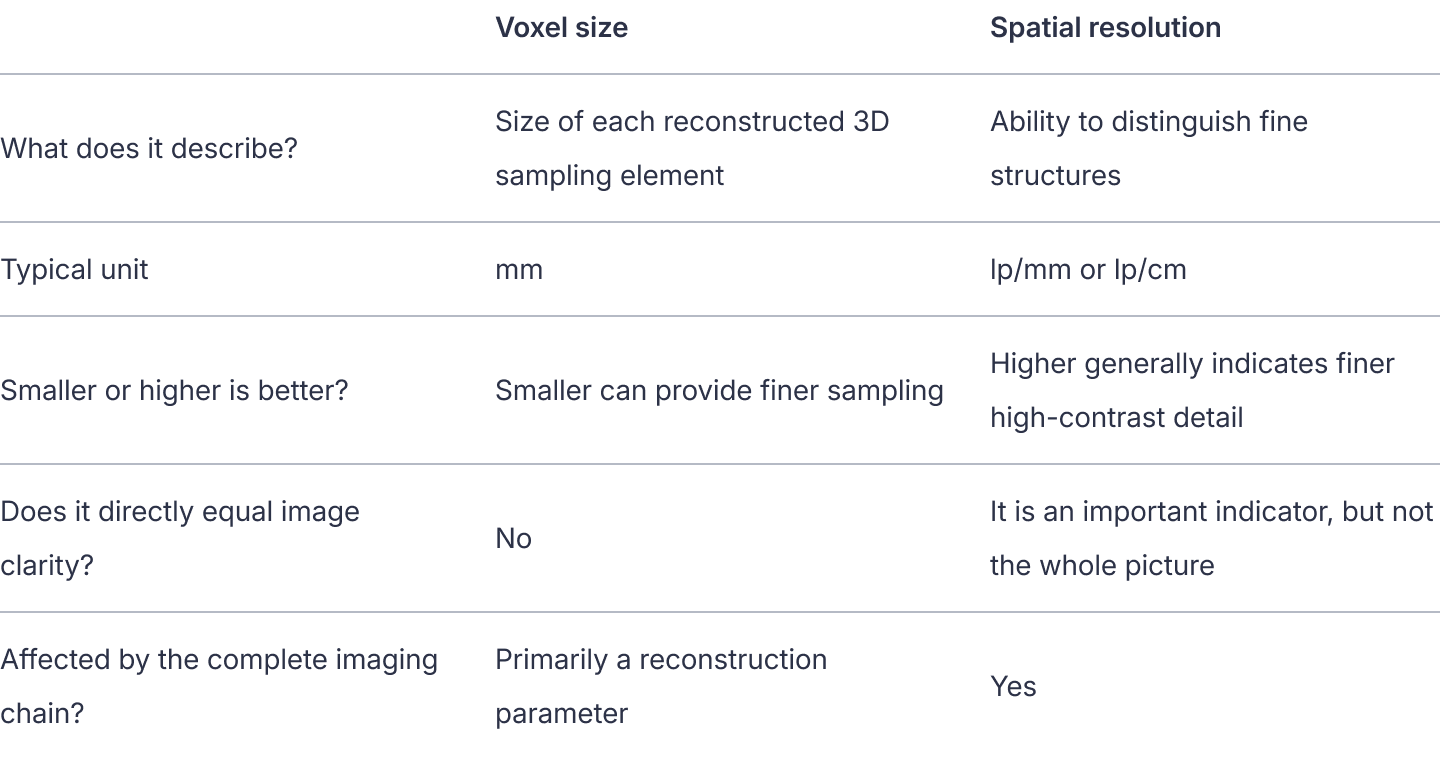
The key distinction is simple:
Voxel size describes the sampling grid. Spatial resolution describes the detail the system can actually resolve.
Look beyond a single specification
When evaluating a dental CBCT system, it can be tempting to compare a single number.
But clinically useful imaging depends on how the complete system performs together.
A small voxel without sufficient detector performance, mechanical stability or reconstruction quality may add data without adding meaningful detail. A high spatial resolution measurement is valuable, but image noise, artefacts and patient motion can still affect what clinicians ultimately see.
At YOFO, image quality is approached as a system-level challenge. X-ray generation, detector performance, mechanical stability, patient positioning, reconstruction and image-processing algorithms are developed to work together, with the objective of preserving clinically useful detail while maintaining efficient workflows and appropriate radiation exposure.
Because in clinical imaging, the goal is not simply to generate more data.
It is to make the detail that matters visible.
Key takeaway
Smaller voxels can support higher-resolution imaging, but voxel size alone does not determine CBCT image clarity. Spatial resolution provides a more direct indication of fine-detail performance, while the final image depends on the entire acquisition and reconstruction system.
 Explore Pirox
 Explore Hiroxis
_1.png) 40%
40% 80%
80%_1.png) 263+
263+ 20+
20+ 1,000+
 NO.1
NO.1





_1.png)